Copper bracelets, rheumatism and osteoarthritis: what does research say?
Copper bracelets have a long association with joint complaints. Explore early positive findings, research on skin contact and later trials in rheumatoid arthritis and osteoarthritis.
Written and source-checked by the Kopero editors · Updated November 23, 2026

A copper bracelet for rheumatism or osteoarthritis is an idea passed down through generations. Personal experiences, research on skin contact and copper's role in the body all contribute to that interest. There are early positive findings from bracelet research too. What was actually tested?
Why copper keeps coming up
Dietary copper contributes to maintaining normal connective tissues and protecting cells from oxidative stress. This helps explain the interest in copper around joint health. These functions concern copper obtained through food; they do not establish a treatment effect from a bracelet.
Rheumatism is a broad term. Rheumatoid arthritis is an inflammatory disease, while osteoarthritis affects the whole joint, including changes to cartilage. Research into one does not automatically answer questions about the other.
The positive findings from 1976
Walker and Keats compared copper bracelets with copper-coloured aluminium bracelets. Their preliminary publication reported that some participants experienced therapeutic value. This positive finding belongs in the history of copper and joint complaints.
These experiences form an early line of research into copper and joint complaints, explored further through skin measurements and controlled bracelet trials.
What happens when copper touches skin?
Interest in copper and inflammation has also been explored experimentally. In 1978, Whitehouse and Walker reported anti-inflammatory activity of copper compounds in rats. In 1981, Dollwet and colleagues observed such an effect in rats with a copper implant. These involve different forms and routes of administration from a bracelet worn on the skin.
In 2006, Hostýnek and colleagues measured copper in the outer skin layer after applying copper powder under a covering. Contact time and access to oxygen mattered. There is measurable interaction between copper and skin. Our article on copper on your skin explains the study.
It studied healthy forearm skin, not joint recovery. Later controlled bracelet trials in osteoarthritis in 2009 and rheumatoid arthritis in 2013 found no convincing specific improvement in pain, stiffness or inflammation from copper bracelets. We therefore offer them as jewellery for everyday wear, without a medical treatment promise.
Choose a bracelet that feels right
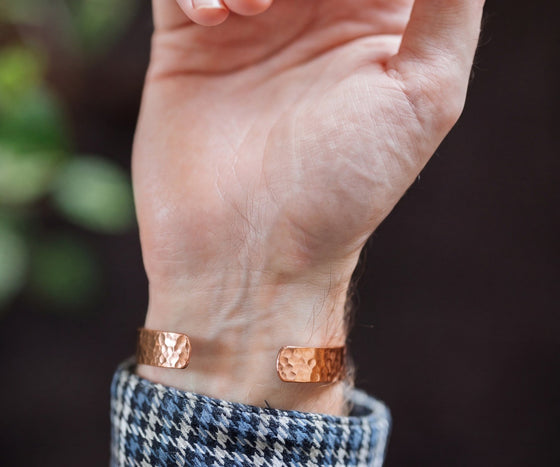
If you would like to wear copper, start with material and fit. The Kopero copper bracelet is solid copper without magnets, with an open shape you can gently adjust. Choose Smooth, Hammered, Twisted or Round.
Smooth, Hammered and Twisted have bare copper on the inside. Round has a thin protective coating all around. Choose the finish you enjoy wearing. Adjust it gently so it does not pinch; comfort comes first on a sensitive or swollen wrist.
A copper bracelet can have its own place in your daily routine. Keep medical care for arthritis with your clinician, and choose your jewellery for its material, finish and comfortable fit.
Sources
- Walker & Keats, 1976 — Agents and Actions 6:454–459Early comparison with placebo bracelets; some participants reported benefit.
- Hostýnek et al., 2006 — Food and Chemical Toxicology 44:1539–1543Copper powder applied to healthy skin; copper measured in the outer skin layer.
- Richmond et al., 2009 — Complementary Therapies in Medicine 17:249–256Controlled osteoarthritis bracelet trial: no convincing specific benefit from copper.
- Richmond et al., 2013 — PLOS ONE 8:e71529Controlled rheumatoid arthritis bracelet trial: no specific therapeutic effect demonstrated.
- EFSA, 2009 — EFSA Journal 7(9):1211Official assessment of dietary copper, including its role in normal connective tissues.
- Whitehouse & Walker, 1978 — Agents and Actions 8:85–90Rat research into the anti-inflammatory activity of copper compounds.
- Dollwet et al., 1981 — Agents and Actions 11:746–749Rat research using a copper implant, not a trial of worn bracelets.
Sources checked on 23 November 2026.