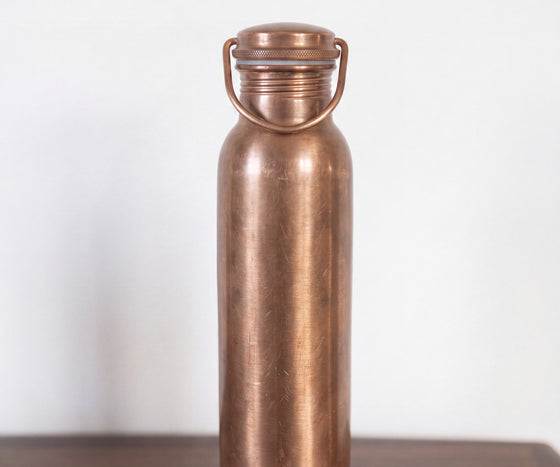
Copper bracelet: benefits, skin contact and everyday wear
Why wear a copper bracelet? Explore solid copper, research on skin contact, and practical advice on fit and care.
Written and source-checked by the Kopero editors · Updated November 3, 2026

Why do so many people choose a copper bracelet?
A copper bracelet stands out without needing much. Its warm colour, the weight of the metal and the shine that changes as you wear it: you can see and feel that you have a real material around your wrist. Some people choose it as everyday jewellery. Others attach a personal ritual to it, or are curious about the contact between copper and their skin.
Search for the benefits of a copper bracelet and you soon encounter all these reasons together. Below, you can read what makes copper distinctive, what researchers have studied about skin contact and how to choose a bracelet you will enjoy wearing.
At a glance
- Solid copper has a warm appearance and develops its own patina as you wear it.
- On Smooth, Hammered and Twisted, the bare copper inside touches your wrist. Round has a thin protective layer all around. Choose the shape and finish that suit your daily ritual.
- The antibacterial properties of copper surfaces have been measured in laboratory research.
- Research into copper ions, skin cells and copper-containing textiles has produced interesting findings for the skin.
- An open bracelet can be carefully adjusted to fit. Smooth, hammered, twisted or round: choose the finish that suits you.
The benefits of copper as everyday jewellery
Copper has a colour you see in few other kinds of jewellery. Its warm tone stands out against a pale blouse; against a dark shirt, the metal gains depth. A smooth bracelet has a quiet appearance. A hammered surface catches the light across many small facets. Twisted copper gives the shape of the metal a more prominent role.
Then there is the character of solid copper. Its colour changes through contact with air, moisture and your skin. You can let that patina develop or restore the shine occasionally. With a solid copper bracelet, the same metal continues beneath the surface. That makes it a piece you can keep wearing and caring for.
Naturally antibacterial
One distinctive property of copper is its ability to inactivate bacteria on its surface. Researchers at the University of Southampton compared copper with materials including stainless steel. In their laboratory experiments, the MRSA strains tested survived for considerably less time on copper. This makes copper an interesting material for frequently touched surfaces. Noyce, Michels and Keevil, 2006.
Research into the antibacterial properties of copper concerns bare copper surfaces. On Smooth, Hammered and Twisted, the inside against the wrist remains bare copper; Round has a thin protective layer all around.
What happens when copper touches your skin?
Contact between copper and skin has also been studied directly. Dermatologists applied copper powder to volunteers’ forearms. Copper was subsequently found in successive layers of the stratum corneum, the outermost skin layer. The amounts differed between people and depended in part on contact time and the availability of oxygen. Hostýnek, Dreher and Maibach, 2006.
On Smooth, Hammered and Twisted, the bare copper inside touches your wrist. Round has a thin protective layer all around. Choose the shape and finish that suit your daily ritual.
Copper, collagen and elastin: what new research shows
Scientific interest in copper and skin extends beyond contact with the material. Collagen and elastin give skin structure and resilience. Copper has a role in the processes that form and stabilise these proteins.
In a study of human skin tissue outside the body, exposure to copper ions increased the release of substances including procollagen I and elastin. This offers insight into how copper can act in skin. Research into copper ions in human skin tissue, 2020.
A 2021 study examined human skin cells. A combination of copper ions and amino acids increased the production of collagen I and elastin. The combination mattered: copper ions alone did not produce the same result at protein level. Chung and colleagues, 2021.
New work also appeared in 2026. Copper Tripeptide-1, a copper peptide, stimulated elastin expression and secretion in skin cells. A combination with two other ingredients was also examined in human skin tissue. It shows that interest in copper and skin continues to develop. Ye and colleagues, 2026.
What about copper held against the skin for longer?
Interesting textile trials have explored this. In a double-blind study, sixty volunteers wore socks with or without copper oxide for four weeks. After four weeks, measured skin elasticity at the ankle had improved in the copper group compared with the control group. Dykes, 2015.
Another randomised study involving 45 women found improvements in some measurements of skin sagging and brightness after using copper oxide-containing pillowcases. Study of copper oxide-containing pillowcases, 2016.
The common thread is that copper can react at the skin surface and has a role in skin processes. The studies use different forms, from copper powder to peptides and copper oxide-containing textiles. Their results describe those applications; they do not establish that wearing a solid copper bracelet improves the skin.
Jewellery with a personal meaning
For many people, part of the appeal is what they associate with their bracelet. A reminder of someone. A gift to mark a new chapter. Or a small daily gesture: putting the bracelet on before the day begins.
Spiritual traditions associate copper with meanings such as connection and grounding. You can include that meaning in your own wearing ritual. Perhaps the bracelet stands for attention, an intention or simply a material you feel drawn to. Read more in the copper bracelet: an age-old tradition.
What about joints and circulation?
Copper is an essential dietary mineral needed for functions including iron metabolism and connective tissue formation. That does not make a bracelet a nutrient source with a demonstrated dose. Improved circulation or treatment of joint symptoms through wearing one has not been established. Placebo-controlled studies in rheumatoid arthritis and osteoarthritis found no convincing benefit for pain, stiffness or physical function. NIH on copper as a nutrient; Richmond and colleagues, 2013; Richmond and colleagues, 2009.
How to wear a copper bracelet comfortably
Choose the wrist where the bracelet feels most comfortable and gets in the way least when you write, work or move. Left or right is a personal choice. Pay particular attention to fit: the bracelet can touch your skin, but should not pinch.
Carefully adjust an open bracelet to fit. Avoid repeatedly bending the metal far apart and closed again. Start wearing it when it suits you, and keep your skin and bracelet clean and dry. There is no need for a compulsory number of hours.
Green marks and care
A green mark sometimes appears on the skin. It can come from copper compounds formed through contact with sweat and personal care products. You can usually wash the mark off. If you experience itching, redness or a burning sensation, take the bracelet off; that is different from a colour mark alone.
Gentle cleaning and thorough drying are enough for everyday care. To restore the shine, follow your bracelet’s polishing instructions and rinse away any residue carefully before wearing it again. The choice between shine and patina is yours. Read more about green and dark discolouration of copper.
Which copper bracelet suits you?
Unsure about the finish? The copper bracelet guide compares the differences. To learn more about magnets, read copper bracelets with or without magnets. This helps you choose by material, comfort and the appearance you enjoy.
Sources
- Noyce, Michels & Keevil (2006). Potential use of copper surfaces to reduce survival of epidemic meticillin-resistant Staphylococcus aureus in the healthcare environment.
- Hostýnek, Dreher & Maibach (2006). Human stratum corneum penetration by copper: in vivo study after occlusive and semi-occlusive application of the metal as powder.
- Ogen-Shtern et al. (2020). Increased pro-collagen 1, elastin, and TGF-β1 expression by copper ions in an ex-vivo human skin model.
- Chung et al. (2021). Synergistic effect of copper and amino acid mixtures on the production of extracellular matrix proteins in skin fibroblasts.
- Ye et al. (2026). Multi-Target Restoration of Dermal Elastic Fibers Through Elastin Upregulation, Elastase Suppression, and Scaffold Reinforcement.
- Dykes (2015). Increase in skin surface elasticity in normal volunteer subjects following the use of copper oxide impregnated socks.
- Baek et al. (2016). Facial Skin Lifting and Brightening Following Sleep on Copper Oxide Containing Pillowcases.
- Richmond et al. (2013). Copper bracelets and magnetic wrist straps for rheumatoid arthritis: a randomised double-blind placebo controlled crossover trial.
- Richmond et al. (2009). Therapeutic effects of magnetic and copper bracelets in osteoarthritis: a randomised placebo-controlled crossover trial.
- NIH Office of Dietary Supplements. Copper: Fact Sheet for Health Professionals.
Sources checked on 23 October 2026.